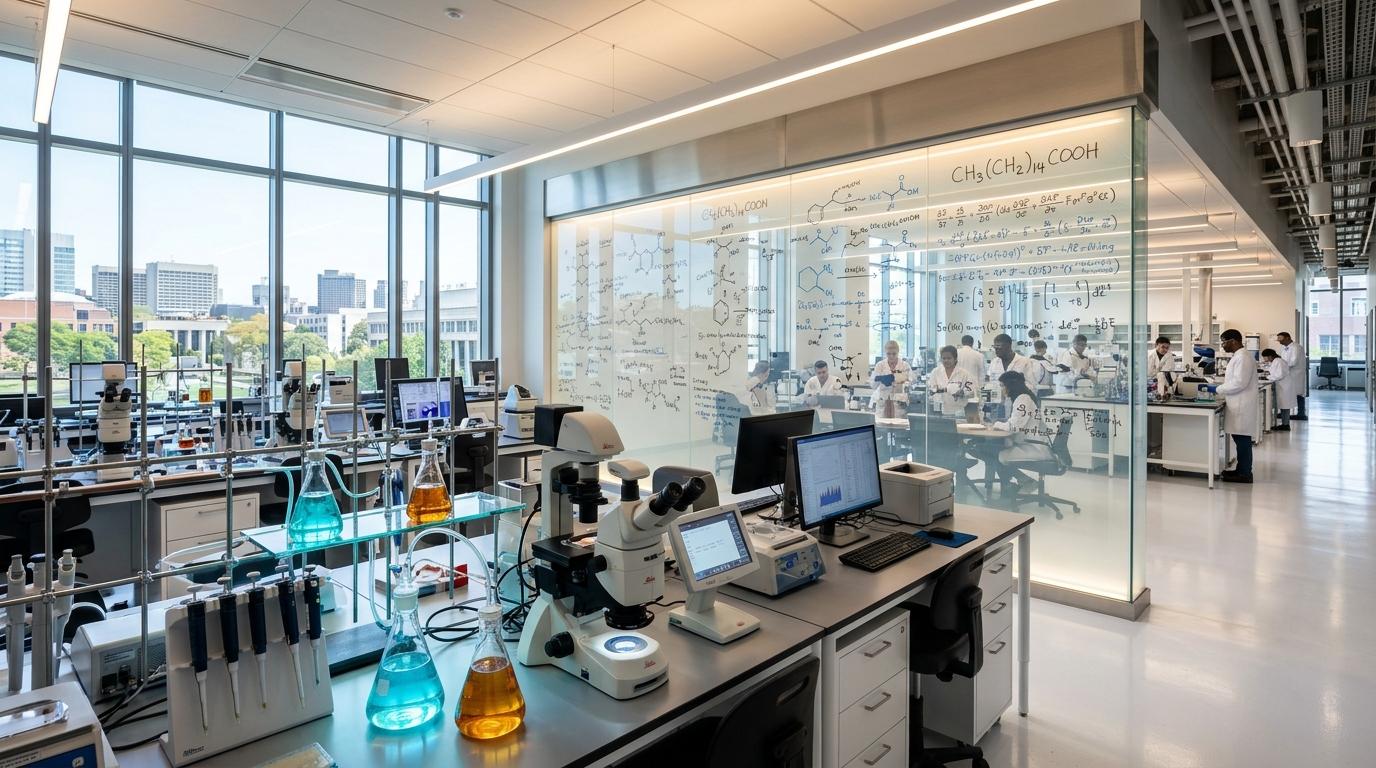
Boston University Summer Term, Boston, Massachusetts
Boston University Research in Science & Engineering (BU RISE)
Six weeks of mentored laboratory research (Internship Track) or computational group discovery (Practicum Track) for rising seniors at Boston University.
Overview: BU RISE
Program mission, scale, and why it matters to top university admissions.
Operated by Boston University Summer Term, BU RISE immerses ~190 rising high school seniors for 6 weeks in either individualized university lab research (Internship Track) or structured group computational research (Practicum Track).
- Selects ~190 rising seniors each summer out of thousands of applicants across two distinct tracks: Internship (40 hrs/week in a BU faculty lab) and Practicum (Computational Neurobiology or Data Science).
- Runs June 27 to August 6, 2027 (residential or commuter), with 2026 tuition totaling $6,415 commuter or $10,735 residential (plus $75 application fee; need-blind limited aid available).
- Strict Eligibility: Open exclusively to current high school juniors (rising seniors) who are US citizens or legal permanent residents.
- Requires 3 short essays (plus a 250-word 3-faculty alignment essay for Internship applicants), full 9th-to-11th transcripts, 1 STEM recommendation, and optional test scores.
Acceptance & Selectivity Funnel
Historical progression data from global registration through finalist commendations and podium honors.
What BU RISE Looks For
Tracks, Judging Criteria & Curriculum Alignment
Internship Track vs. Practicum Track & Eligibility
- Internship Track (1-on-1 Lab Research) vs. Practicum Track (Group Computational)
- Internship Track: 40 hours/week working under a BU faculty mentor across biology, BME, chemistry, CS, physics, neuroscience, or public health.
- Practicum Track: Morning lectures + afternoon group computational research (Computational Neurobiology or Data Science) + weekly biotech site visits.
- Rising Senior US Citizen/PR Rule & Tuition Aid
- Open strictly to current 11th graders (rising seniors) who are US citizens or legal permanent residents.
- Admissions are need-blind, with limited need-based financial aid (requires parent tax returns by the February 3 deadline).
BU RISE Essays, Faculty Matching & Transcript Standards
- Three Core Essays + 250-Word Faculty Alignment Essay
- All applicants write 3 essays: subject interest (300 words), academic achievements (250 words), and why RISE (200 words).
- Internship applicants also list 3 specific BU faculty members and explain how their research aligns (250 words max).
- Competitive Transcripts, Recommendation & Poster Symposium
- Requires Grade 9 through fall 2026 transcripts (typical admits hold an A- to A average), 1 STEM recommendation, and optional SAT/ACT/PSAT.
- Both tracks culminate in the BU RISE Poster Symposium presenting summer findings.
Curriculum Mapping & Target University Majors
- AP, IB and Selective US STEM Alignment
- Pairs strongly with AP/IB Biology, Chemistry, Physics C, Computer Science A, and Calculus BC.
- International students are ineligible for BU RISE and should target SSP or Rockefeller SSRP instead.
- Supported Undergraduate Degree Pathways
- Biomedical Engineering, Neuroscience, Data Science, Computer Science, and Biology.
- Chemistry, Physics, Astronomy, and Public Health.
Past Prompts & Winning Framework
Deconstruct real prompts and case studies through our analytical evaluation framework.
“Explain why you selected your STEM subject of interest and how you have explored it inside and outside the classroom.”
Narrow your subject down to a concrete subfield (such as neural spike-train decoding or microfluidic diagnostics) rather than broad 'biology' or 'engineering.'
Highlight specific independent projects, coding models, or lab techniques you have already practiced in school or clubs.
Avoid repeating your transcript grade list; focus on what open scientific questions still puzzle you.
Show how 6 full-time weeks at BU bridges your high school curiosity to university-grade experimentation.
“List three Boston University faculty members you are interested in working with this summer and explain how their research interests align with yours.”
Verify from the BU departmental directory that all three chosen professors actually take undergraduate/RISE lab students in your target subfield.
Dedicate 70 to 80 crisp words to each faculty member, naming a specific project or recent paper from their lab rather than generic website slogans.
Make sure your three chosen labs share a coherent methodological thread (such as computational genomics or optogenetics) so your profile looks focused.
Note any Python, wet-lab, or CAD skills you bring that match those three labs' daily workflows.
6-Month Preparation Timeline
Six-month preparation plan for the February 3 BU RISE deadline.
Track Choice & BU Faculty Directory Audit
- Decide between the individualized Internship Track and the computational Practicum Track.
- Browse BU STEM faculty pages to shortlist 3 active professors whose recent papers match your skills.
Transcript, Scores & Recommender Setup
- Compile your Grade 9 through Fall 2026 transcript and decide whether to include optional SAT/PSAT scores.
- Brief 1 STEM teacher or counselor before winter break so their letter arrives by February 3.
Four-Essay Drafting & Financial Aid Docs
- Draft the 300-word subject essay, 250-word achievements essay, 200-word why-RISE essay, and 250-word 3-faculty alignment essay.
- Prepare parent tax forms if applying for BU need-based aid.
Portal Submission & Lab Placement
- Submit your complete application, recommendations, and aid documents by February 3, 11:59pm ET.
- Watch for decisions 6 to 8 weeks later in late March.
Important Deadlines for BU RISE
2026 to 2027 BU RISE Application & Summer Schedule
Admissions Strategy & Tips
Common Pitfalls to Avoid
Picking Three Unrelated BU Professors in the Faculty EssayListing one robotics prof, one marine biologist, and one astrophysics prof makes your application look unfocused and complicates lab matching.
Missing the Same-Day February 3 Financial Aid & Rec CutoffUnlike programs with later document deadlines, BU RISE requires your essays, recommendation, and financial aid tax returns all by February 3.
Applying as an International StudentBU RISE is strictly limited to US citizens and permanent residents; international students cannot attend.
Frequently Asked Questions: BU RISE
Common queries from applicants and families about admissions.
Quick Facts
Key Dates & Deadlines
Aiming for a Commendation or Global Podium?
Work 1-on-1 with past evaluators and top medalists who guide your research, review drafts, and run mock oral defenses.
Match Me With a MentorRelated Competitions
Get Mentorship for Boston University RISE
Work 1-on-1 with STEM researchers on BU faculty matching and RISE essays.