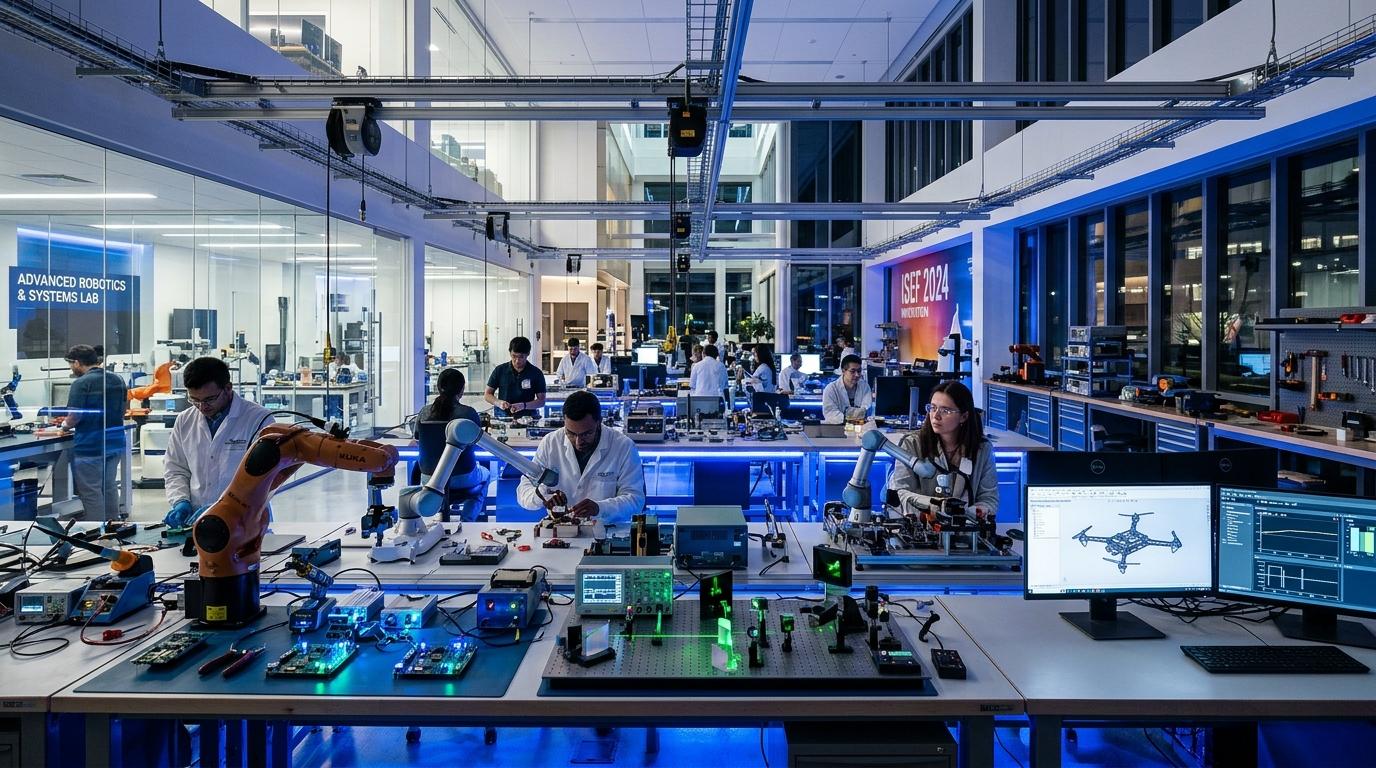
Society for Science & ExSTEMplar (IRIS National Fair)
Regeneron ISEF & IRIS National Fair
The world's largest pre-college scientific research showcase, accessible to Indian students exclusively through the IRIS National Fair pipeline.
Overview: Regeneron ISEF & IRIS
Program mission, scale, and why it matters to top university admissions.
Regeneron ISEF evaluates original, hypothesis-driven scientific experimentation or engineering design conducted over up to 12 continuous months, audited by a Scientific Review Committee and defended in live 15-minute interviews.
- Founded in 1950 globally and 2006 in India (IRIS National Fair), bringing together over 1,600 finalists from 70+ countries to compete for 9 million in awards.
- Indian students qualify exclusively through the IRIS National Fair, which screens 3,000+ project entries down to 100 national finalists and selects ~20 Grand Award winners for Team India.
- Judged by over 1,000 PhD and MD scientists, university faculty, and 50+ Special Award Organizations including IEEE, NASA, Google, and the U.S. Air Force.
- Highlighted directly on MIT Admissions' official STEM portal, an ISEF Grand Award or Team India slot is one of the strongest research credentials in global college admissions.
Acceptance & Selectivity Funnel
Historical progression data from global registration through finalist commendations and podium honors.
What Regeneron ISEF & IRIS Looks For
Tracks, Judging Criteria & Curriculum Alignment
22 ISEF Categories, Team Rules & Ethics Pre-Approval
- Twenty-Two Official Categories Across Four STEM Families
- Life Sciences (7): Animal, Behavioral/Social, Biochemistry, Biomedical/Health, Cellular/Molecular, Microbiology, and Plant Sciences.
- Physical, Computational & Engineering (15): Chemistry, Earth/Environmental, Materials, Math, Physics/Astronomy, Computational Bio, Software, Robotics, Embedded Systems, Biomedical/Environmental/Statics Engineering, Energy, and Translational Medicine.
- IRIS India Solo or 2-Person Team Limit
- IRIS National Fair accepts solo projects or teams of exactly 2 students (Classes 5 to 12; Grades 9 to 12 eligible for Team India ISEF).
- Projects may cover at most 12 continuous months of research and must maintain a bound, chronological ink logbook.
- Mandatory Prospective SRC / IRB Ethics Forms (Forms 1 to 7)
- Every entrant completes Form 1, Form 1A, Form 1B, and a Research Plan; lab projects also require Form 1C and Form 2.
- Human participants (including simple surveys, Form 4), vertebrate animals (Form 5A/5B), and biological agents (Form 6A) require signed approval BEFORE data collection begins.
Official 100-Point Science & Engineering Judging Rubric
- Research Question (10 pts) & Design/Methodology (15 pts)
- Science Track: Testable hypothesis, variable isolation, negative/positive controls, and sufficient sample replicates.
- Engineering Track: Quantifiable engineering need, target design constraints, and iterative prototype build-and-test cycles.
- Execution, Data Collection & Statistical Analysis (20 pts)
- Science Track: Reproducibility, error propagation, p-values, ANOVA/t-tests, or ROC-AUC benchmarks.
- Engineering Track: Systematic stress-testing of the prototype against commercial baselines under realistic conditions.
- Creativity (20 pts), Poster (10 pts) & Live Interview (25 pts)
- Judges weight Creativity and the 15-minute oral defense (45 points combined) nearly half of the total score.
- For team projects, both partners must demonstrate equal command of the methodology and math during questioning.
Curriculum Mapping & Target University Majors
- IB Diploma and Advanced Placement Alignment
- IB DP: Extended Essay and HL Internal Assessments in Physics, Chemistry, Biology, Computer Science, and Math AA.
- AP: AP Research, Physics C, Chemistry, Biology, Computer Science A, Calculus BC, and Statistics.
- CBSE, ISC and Cambridge A-Level Alignment
- CBSE and ISC: Class 11 and 12 Physics, Chemistry, Biology, Computer Science, Biotechnology, and INSPIRE/ATL projects.
- Cambridge A-Level: Physics (9702), Chemistry (9701), Biology (9700), Computer Science (9618), and Further Math (9231).
- Supported Undergraduate Degree Pathways
- Engineering & CS: Computer Science, AI, Electrical/Mechanical/Biomedical/Chemical Engineering, and Materials Science.
- Pure Sciences & Pre-Med: Molecular Biology, Neuroscience, Chemistry, Physics, Astrophysics, and Pure/Applied Mathematics.
Past Prompts & Winning Framework
Deconstruct real prompts and case studies through our analytical evaluation framework.
“Formulate a falsifiable scientific hypothesis in Life or Physical Sciences, execute controlled multi-replicate experiments with prospective SRC/IRB approval, and defend your statistical conclusions.”
Identify a specific mechanistic question in peer-reviewed literature and secure all required IRB/SRC signatures (Forms 1, 1A, 1B, and 4/5A/6A if applicable) in your bound logbook before Day 1 of experimentation.
Run at least 3 to 5 independent experimental trials with explicit positive and negative controls, recording raw timestamped observations in pen inside your physical project data book.
Perform parametric or non-parametric statistical tests (t-tests, ANOVA, confidence intervals) to rule out random noise, instrument drift, and confounding variables.
Package your findings into a 250-word abstract, 90-second video, and quad-chart/tri-fold board, and drill a 90-second elevator pitch plus 13 minutes of technical Q&A.
6-Month Preparation Timeline
Six-month experimental research and IRIS submission roadmap.
Literature Matrix, Logbook & SRC Forms
- Initialize a bound, page-numbered physical research logbook and compile a 20-paper literature review.
- Complete prospective SRC/IRB ethics approvals (Forms 1, 1A, 1B, and 4/6A if needed) before collecting data.
Experimental Trials & Prototype Iterations
- Execute multi-replicate experiments or 3+ engineering prototype iterations with timestamped raw data logs.
- Obtain signed Form 1C if any testing was performed inside a university or corporate laboratory.
Statistical Validation & Research Paper
- Run statistical hypothesis tests (p-values, error bars, ablation benchmarks) on all experimental data.
- Write the full research paper, 250-word abstract, and project synopsis.
90-Second Video & IRIS Portal Upload
- Film the mandatory 90-second project video and design your scientific poster.
- Upload your complete forms, synopsis, and video to the IRIS portal before October 13.
Important Deadlines for Regeneron ISEF & IRIS
Annual IRIS National Fair & Regeneron ISEF Timeline
Admissions Strategy & Tips
Common Pitfalls to Avoid
Signing Ethics Forms After Starting ExperimentsSigning Form 4 (Human Participants, including student surveys) or Form 6A (Biological Agents) after data collection begins causes automatic SRC disqualification.
Culturing Unknown Bacteria at Home or SchoolSwabbing surfaces or river water and culturing unknown microorganisms outside a certified BSL-2 laboratory is strictly banned under ISEF safety rules.
Using Generative AI to Write the Abstract or CitationsISEF forbids using AI to draft project text or generate bibliography citations. Any AI used as a computational research tool must be cited explicitly.
Backdating a Logbook or Assembling Off-the-Shelf KitsWriting a logbook in one sitting or assembling an Arduino sensor kit without original engineering design and statistical testing fails the 25-point live interview.
Frequently Asked Questions: Regeneron ISEF & IRIS
Common queries from applicants and families about admissions.
Quick Facts
Key Dates & Deadlines
Aiming for a Commendation or Global Podium?
Work 1-on-1 with past evaluators and top medalists who guide your research, review drafts, and run mock oral defenses.
Match Me With a MentorRelated Competitions
Get Mentorship for Regeneron ISEF & IRIS National Fair
Work 1-on-1 with PhD researchers on experimental design, SRC compliance, and oral defense coaching.